Krites
AI agent verification harness
An open-source Claude Code plugin that runs the repository’s checks itself, blocks the agent’s stop when one fails, and signs a receipt of what ran.
Problem
A coding agent will report that the tests pass. Asking it to run them is a request it can skip.
Krites removes the request. When the agent tries to stop, a hook outside the agent loop runs the repository’s own checks and reads their exit codes. The first failure blocks the stop and goes back to the agent, up to three times in a row by default.
Execution
Four Claude Code hooks in plain Node, with no runtime dependencies. One denies the agent’s edit tools on protected paths, such as the tests. One runs the checks at every stop. One holds the agent’s commit until the last run passed on the same tree. One records the baseline each session is judged against.
github.com/krites-dev/krites (opens in a new tab)
- Edit / Write
- PROTECT — denies agent edits on protected paths such as tests
- git commit
- COMMIT — holds commit until the current tree passed checks
- Stop
- GATE — runs the repository's approved checks and inspects exit codes
- Exit 0
- Stop allowed and session completes cleanly
- Non-zero
- Stop blocked; failing command output returned to agent
/krites:receipt (human-triggered) exports Ed25519-signed JSON verified offline.
A repository’s krites.toml runs nothing until a person has reviewed and approved it. The approved hash is kept outside the repository, so a cloned or changed config cannot run checks on its own.
A run exports as a receipt: each command, its exit code, the files changed, and the commit, signed with Ed25519. Tokens, passwords, and home-directory paths are scrubbed first. One dependency-free file verifies a receipt offline.
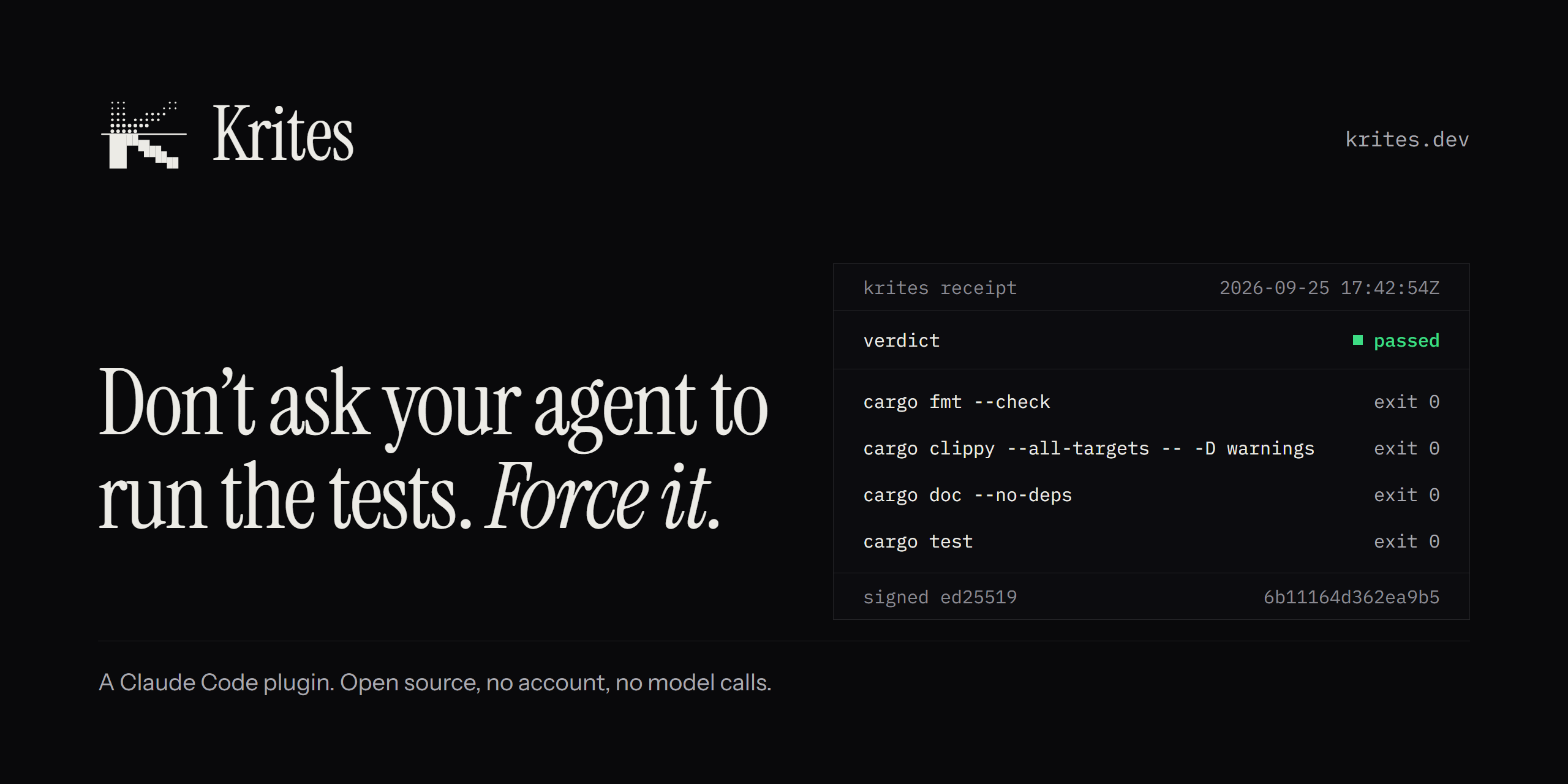
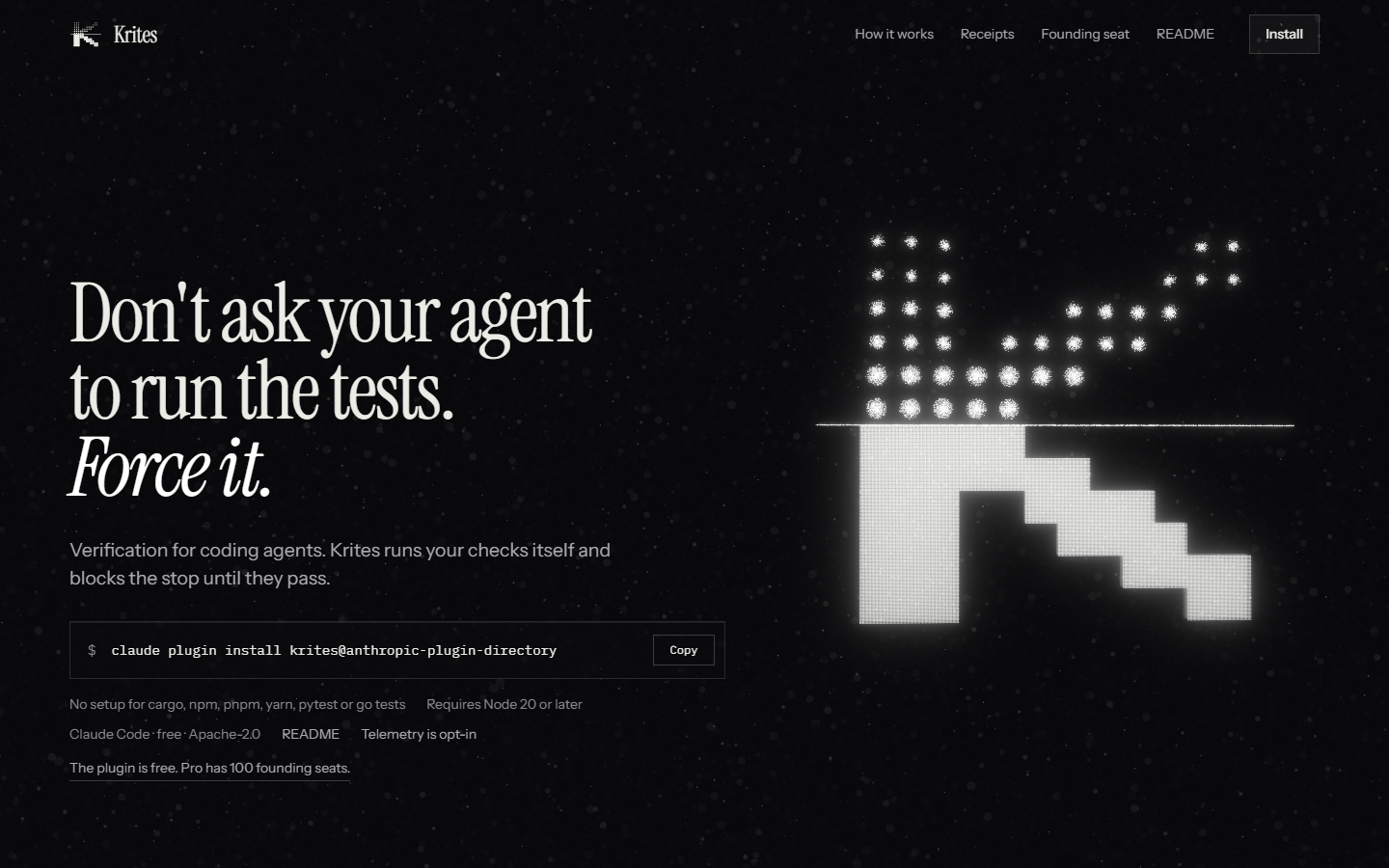
The site at krites.dev draws its figures in hand-written WebGL2, with zero Three.js.
krites.dev (opens in a new tab)
Numbers
- Plugin
- 11k lines of JavaScript, 7.6k of them tests
- Runtime dependencies
- 0
- Hooks
- Protect · stop gate · commit hold · session baseline
- Receipts
- Ed25519-signed, verified offline
- License
- Apache-2.0, open source
- Site
- 3.1k lines · WebGL2 · zero Three.js